Guide
Daily Office Commute in Bangalore: Cabs, Metro, Buses, Bike Taxis and Carpools Compared
App cabs cost more, bike taxis face safety and legal questions, and metro and buses are crowded. A clear comparison of every daily office commute option in Bangalore.
By Flow TeamPublished 9 min read
The daily office commute in Bangalore is not one problem but a chain of them: a congested road, a fare that moves with demand, a metro station that is a few kilometres from home, and a last mile that nobody quite owns. Every option people use today solves part of that chain and leaves another part exposed. This guide compares those options plainly, using published data where it exists, and then explains where a fixed-route shared office cab, the model Flow is building, fits in.
Why the daily office commute in Bangalore is so hard to plan
Distance is rarely the real issue. TomTom's 2025 Traffic Index puts Bengaluru's average congestion level at 74.4%, and the city page of the index reports an average of 36 minutes 9 seconds to cover 10 km. In the evening rush, the same 10 km takes about 45 minutes 27 seconds at an average speed of 13.2 km/h. TomTom estimates 168 hours lost to traffic in a year, and news reports describe the city as the world's second most congested in the 2025 ranking.
For an office-goer, that translates into two separate costs. The first is time. The second is uncertainty: a trip that takes 35 minutes on Monday can take 60 on Tuesday, so people leave early, arrive tired and plan their evenings around the road. Any commuting option is best judged on both counts, along with cost, comfort and safety. Flow has also written about why peak hour wears you down and what actually helps, which pairs well with this comparison.
App cabs: door to door, but the fare is unpredictable
Ola, Uber and Rapido remain the default for many professionals because they are convenient and reach almost any address. The complaint is cost. Karnataka's transport department has introduced a uniform kilometre-based fare for cabs and barred surge pricing, but a Deccan Herald report quoted riders who said app fares had risen 30% to 60%, and a transport official who said the fare structure had not been enforced against the companies. Namma Yatri told the newspaper it applies an average 20% congestion fee on cabs during rush hours, to compensate drivers for the extra fuel and time.
Those are riders' accounts and company statements rather than an audit of fares, and prices vary by route and hour. The practical point for a daily commuter is narrower: a price that can change every morning is hard to budget for, and two trips a day for 22 working days adds up quickly. For a closer look at that trade-off, see Flow's article on why an office cab subscription can beat booking a cab every day.
Autos and bike taxis: quick on paper, uncertain in practice
Autos and bike taxis are attractive for short, congested stretches, but they carry three separate concerns.
- Legal status. In January 2026, the Karnataka High Court lifted the state's ban on bike taxis, holding that the state could regulate the sector but not ban it outright. The state has since appealed to the Supreme Court, and Deccan Herald reported a transport department drive that seized 263 bike taxis in Bengaluru, with the appeal yet to be decided. Availability on apps can therefore change at short notice.
- Safety. In its Supreme Court submissions, Karnataka cited passengers' accident vulnerability, the higher fatality rate associated with two-wheelers, uncertainty about insurance cover for a passenger's death, and women's safety. Those are the state's arguments in a live case, not settled findings, but they explain why many commuters are cautious.
- Dust and exposure. A CSTEP study based on 2019 emission estimates found that soil and road dust accounted for 51.1% of Bengaluru's PM10, the largest single source. The study is several years old, so treat the number as indicative. It is reasonable to infer that people travelling in open vehicles, such as two-wheelers, are more exposed to roadside dust than those in a closed car or cab, though the study does not measure commuter exposure directly.
Metro and BMTC buses: affordable, but crowded and not door to door
Public transport is the cheapest way to cross the city, and it works well for people who live and work near a line. The weak points are crowding and access.
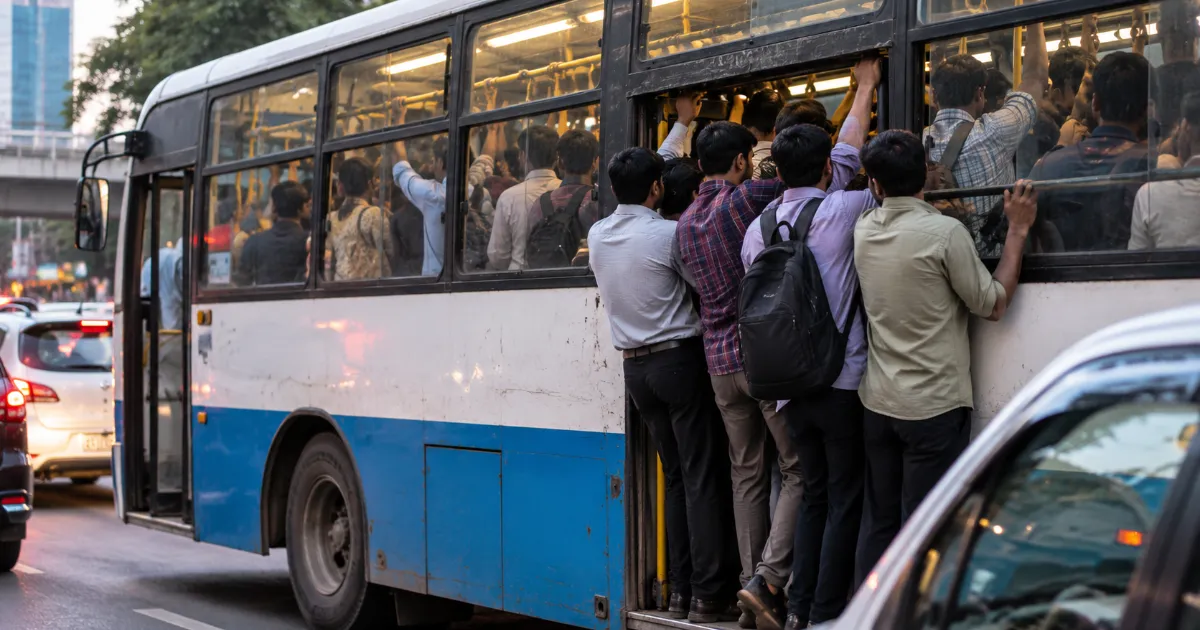
On Namma Metro, The South First reported that crowding is worst between 9 am and 11 am and between 5 pm and 8 pm on the Purple and Green lines, with Majestic especially difficult. Platforms are about 135 metres long and hold six-coach trains, so capacity cannot easily be increased by adding coaches.
The larger issue is the first and last kilometre. BMTC carries roughly 40 lakh passengers a day, yet a 16 October 2026 report notes that some neighbourhoods remain out of reach of the existing fleet, because large buses struggle on narrow roads. The state has approved 200 minibuses to serve Metro stations, with flat fares of Rs 5 or Rs 10 under consideration, but the details are still being worked out. Until then, anyone not living on or near a main road usually needs an auto, a bike taxi or a long walk to complete the journey. Flow's guide to office pickup and drop services in Bangalore covers door-to-door alternatives for exactly this gap.
Carpooling with strangers: cheap in theory, trust is the sticking point
Sharing a car with colleagues or neighbours cuts cost and takes vehicles off the road. In practice, informal carpools depend on trust and logistics: who the co-rider is, whether the driver is vetted, what happens when someone cancels at 8 am, and who is accountable if something goes wrong. Many commuters are reluctant to share a ride with an unknown person on an unfixed schedule. That reluctance is a reasonable response to uncertainty rather than a prejudice, and it is the main reason carpooling struggles to become a dependable daily habit. Flow's safety page describes how it approaches driver checks and fixed co-passengers.
The options side by side
| Option | What works | Main limitation |
|---|---|---|
| App cab (Ola, Uber, Rapido) | Door to door, available on demand | Fares can change by hour; costly for daily use |
| Auto | Good for short, congested stretches | Fare disputes; open to dust and weather |
| Bike taxi | Fast through traffic | Legal status in flux; safety concerns raised by the state |
| Namma Metro | Predictable, relatively inexpensive | Crowded at peak; needs a last-mile link |
| BMTC bus | Wide network, low fares | Crowding; some areas poorly served |
| Informal carpool | Shared cost | Trust, scheduling and accountability |
Where a fixed-route shared office cab fits in
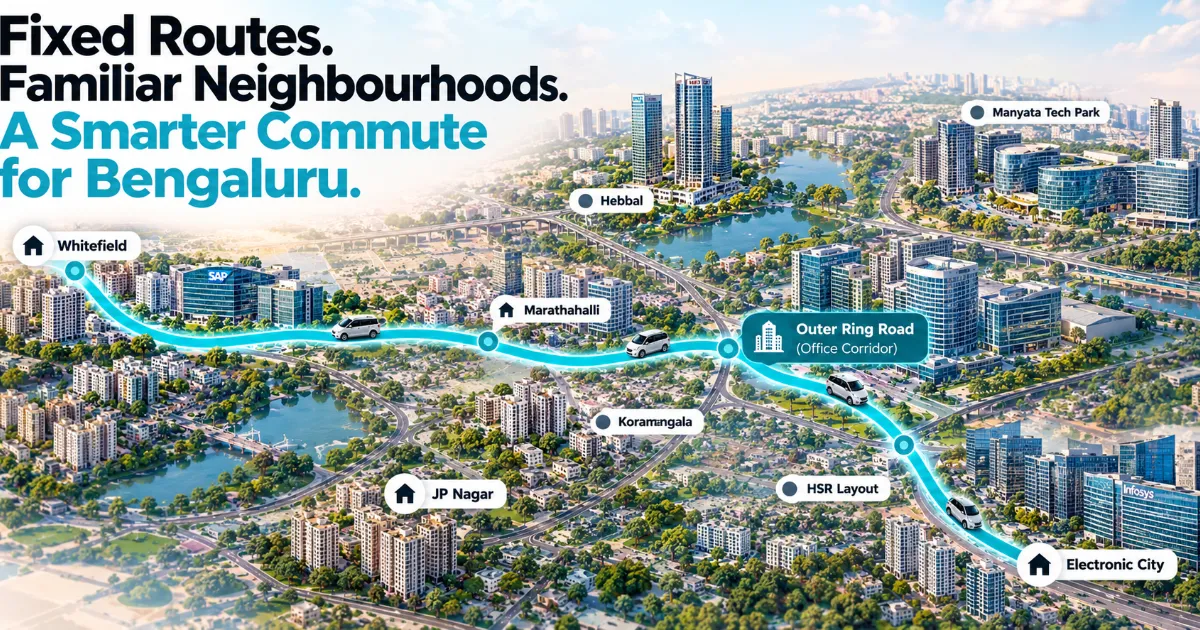
A fixed-route shared cab is built around a single repeated journey. Instead of booking a fresh ride every morning, riders join a route with a set pickup window and a small group of regular co-passengers. The idea targets the gaps above: a predictable price instead of fluctuating fares, a closed vehicle instead of an open one, and familiar co-riders instead of strangers.
Flow is building this for Bangalore office commuters. Its website lists planned routes such as HSR Layout to Bellandur and Ecospace on the Outer Ring Road, Whitefield and ITPL to Indiranagar and Marathahalli, and Electronic City to Koramangala and BTM Layout. The routes are described as launching, and Flow is currently collecting names on a waitlist, so availability depends on your corridor. Its safety page says drivers undergo police verification and licence checks, that rides are tracked live and that co-passengers stay fixed. These are the company's own statements and the page does not cite an independent audit, so ask for the detail before you rely on them.
How to choose your daily route
No single option wins on every measure, so it helps to be specific about what matters most.
- Write down your door-to-door time, including the walk, the wait and the last-mile ride, for both the morning and evening trip.
- Add up a full month of cost, not one ride. Multiply by your actual office days.
- Decide your non-negotiables. Safety after dark, a seat, or an air-conditioned vehicle may matter more than the last rupee.
- Check how the service handles problems: cancellations, no-shows, a work-from-home day or a missed pickup. Questions about a specific service can usually be answered in its Help Center.
- Test for a week before committing to any monthly plan.
Frequently asked questions
What are the main options for a daily office commute in Bangalore?
Commuters generally choose between app cabs, autos, bike taxis, Namma Metro, BMTC buses, informal carpools and, increasingly, fixed-route shared cabs run on a subscription basis.
Why do Ola and Uber feel expensive for daily office travel?
Fares on app cabs can vary by time and demand, and riders have reported increases of 30% to 60% in a Deccan Herald report. For a daily commuter, the cost repeats over roughly 22 working days a month, so even small differences add up.
Are bike taxis legal in Bangalore right now?
The High Court lifted the state's ban in January 2026, but the state has appealed to the Supreme Court and has continued enforcement drives. The position can change, so check current notices before depending on them for a regular commute.
Is the metro a good option for office commuters?
It can be, if your home and office are both near a line. Peak-hour crowding and the first-and-last-kilometre gap are the usual drawbacks.
A predictable commute matters more than a perfect one
Bangalore's traffic will not clear quickly, and no mode of transport removes every drawback. What commuters can control is how predictable the journey is: a known price, a known pickup time and known co-riders. Weigh each option against your own route and hours, and treat any service, including Flow, as one candidate to test rather than a guarantee. If a fixed-route shared cab suits your corridor, you can join the Flow waitlist and check whether your route is covered.
- #Bangalore traffic
- #daily office commute
- #office cab
- #shared cab
- #Namma Metro
- #BMTC
- #bike taxi
- #Ola and Uber
- #last-mile connectivity