Commute insights
Bengaluru Metro Commute Cost: What You Really Pay Each Month
Namma Metro fares look cheap, but autos, parking and lost time add up. Here is what a Bengaluru metro commute really costs each month, and how to cut it.
By Flow TeamPublished 7 min read
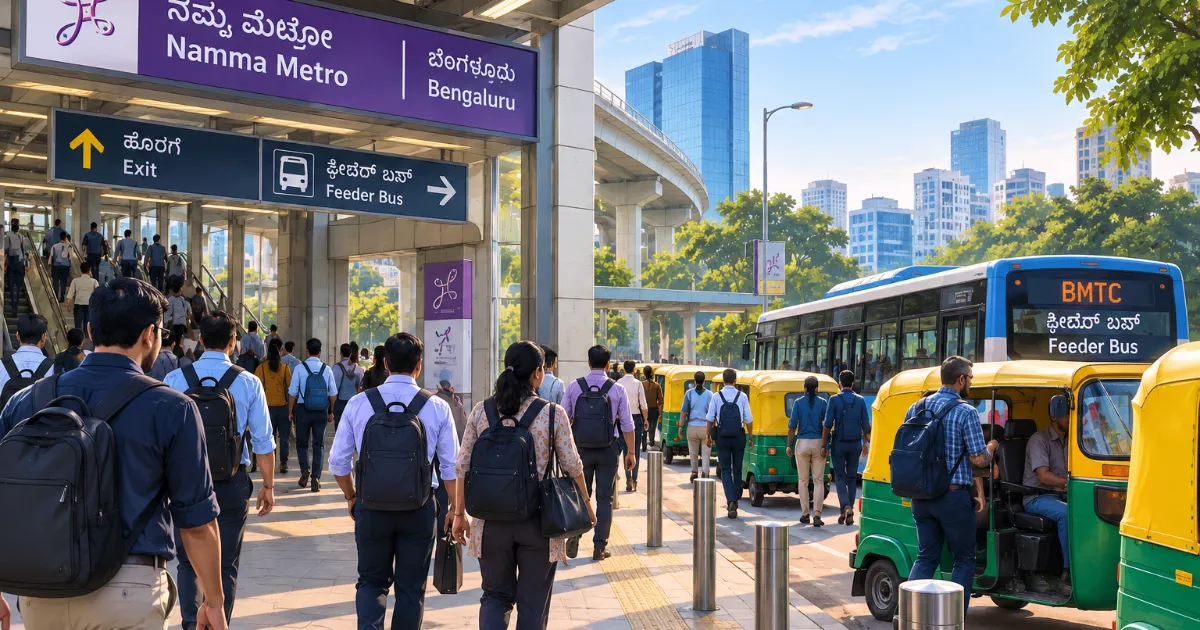
The Bengaluru metro commute cost on your ticket is only part of what you actually pay to get to work. A Namma Metro fare of Rs 40-45 each way looks cheap until you add the auto to the station, the parking, and the extra time spent on the last stretch. With the network now at about 96 km and the Pink and Blue Lines still being readied, this is a good moment to work out what your daily commute really costs.
This guide breaks down the numbers reported by commuters, explains why the "last mile" is where the budget and the time leak away, and compares the realistic options for an office-goer in Bengaluru.
What the Bengaluru metro commute cost really includes
Most people quote the metro fare and stop there. In practice, a metro commute has three cost layers:
- The metro fare itself, which is the part you see on the card or app.
- First-mile and last-mile travel: an auto, a feeder bus, a scooter or a short cab ride at each end.
- Parking and incidentals: station parking, fuel for a two-wheeler, and the time lost waiting.
A recent report by personal finance experts, cited by Deccan Herald on 14 October 2026, estimated monthly metro fares plus first- and last-mile travel at Rs 3,520. The same report said a commuter would need a monthly income of about Rs 70,400 to carry that cost comfortably, which is roughly 5% of income.
Real commuters often report more. The same Deccan Herald story quotes a Basaveshwaranagar-to-Banashankari rider paying Rs 40-45 per metro trip each way, plus Rs 150-200 a day on autos or buses at either end. She spends about Rs 6,000 of a roughly Rs 30,000 monthly income, or around 20%, on getting to work.
Real commuter examples: where the money goes
The reported cases show how quickly the extras add up:
| Commuter profile | Reported spend | Where the extra goes |
|---|---|---|
| Basaveshwaranagar to Banashankari | About Rs 6,000 a month | Rs 150-200 daily on autos or buses |
| Home about 1 km from the nearest bus stop | About Rs 3,960 a month | Scooter or auto to reach the station |
| Rajajinagar to Whitefield | About Rs 4,000 metro fares plus Rs 500 fuel | Scooter to the station |
| Office 6 km from the station | About Rs 150 per auto trip | Auto for the final stretch |
| Commuter who parks at the station | About Rs 4,000 metro fares | Parking of Rs 30-50; door-to-door trip over 1.5 hours |
Two lessons stand out. First, the final 1-6 km often costs as much as the metro ride itself. Second, the time penalty matters as much as the money: a door-to-door journey of more than 1.5 hours is not unusual even when the metro portion is quick.
Why the last mile is the weak link
Mobility expert Satya Arikutharam estimates that poor last-mile links and limited capacity cut the metro system's potential by 18-20%. Other issues raised in the reporting include:
- Feeder gaps: A BMTC feeder between Cubbon Park and Vasanthnagar reportedly runs only on weekdays, and parked vehicles and autos can block feeder bus stops near some stations.
- Parking shortfalls: Some station lots are inadequate, pushing riders to pay Rs 100-150 at nearby malls.
- Frequency and capacity: Most trains arrive every 5-6 minutes and platforms are built for up to six coaches, which limits how much crowding can ease.
BMTC says it runs 3,116 daily trips to metro stations on 253 routes, serving about 1.5 lakh passengers, and that its Namma BMTC 2.0 app supports integrated ticketing and journey planning. It also says feeder connections are being strengthened for six upcoming Pink Line stations on Bannerghatta Road.
What is changing: Pink Line, Blue Line and the 100 km target
Namma Metro marked 15 years on 20 October 2026. The network is now about 96 km, and the operator plans to go past 100 km. The Pink Line's elevated section between Kalena Agrahara and Tavarekere is still awaiting safety clearance, and no opening date has been announced.
On the Blue Line, Greater Bengaluru Development Minister Krishna Byre Gowda said a trial run between KR Puram and Marathahalli is expected by October-end, according to Deccan Herald on 22 October 2026. That is a trial run, not a commercial opening, and road widening and pipeline issues have been flagged as hurdles. Plan around current services until official dates are confirmed.
How to cut your daily commute cost
You cannot fix the city's feeder network, but you can make smarter choices:
- Price the whole door-to-door trip. Add metro fare, first and last mile, parking and fuel for 22 working days, then compare it with other options.
- Check the feeder bus first. BMTC feeder routes to stations can be cheaper than an auto; confirm timings and whether a route runs on weekends.
- Avoid paying for station parking daily if a shared auto or bus covers the same distance.
- Value your time. A saving of Rs 50 a day is not worth it if it adds 40 minutes to the journey.
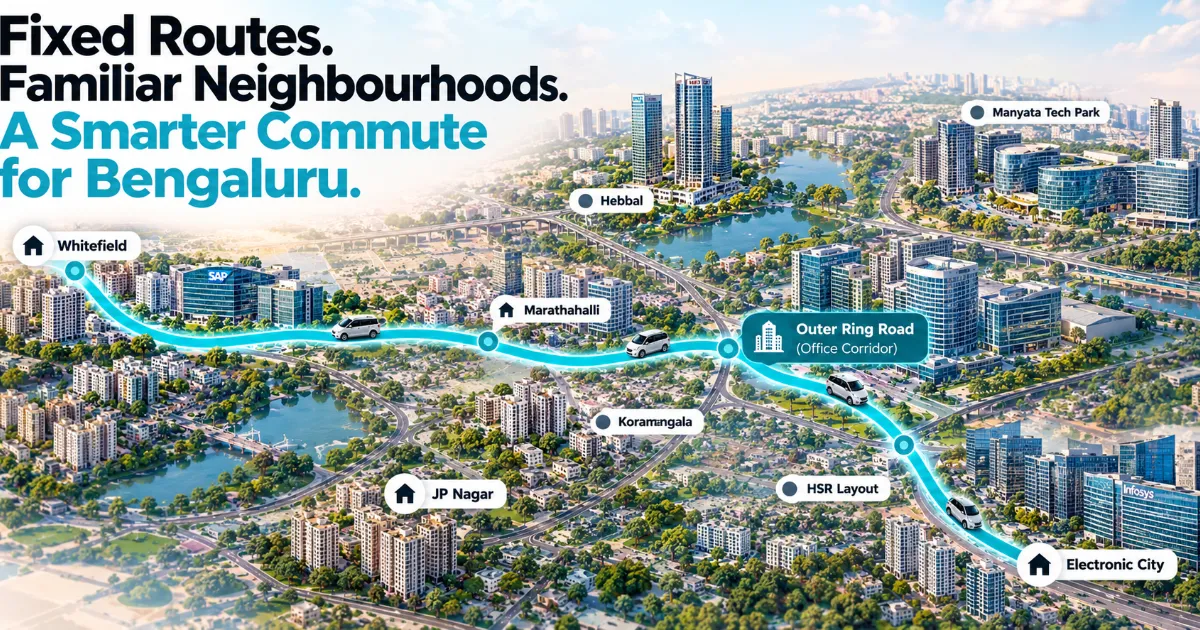
- Compare a fixed-route shared cab. If your home and office are on a common corridor, a shared office cab with a fixed pickup can replace the metro-plus-auto chain with one seat.
For a deeper look at why peak hours drain so much energy, read our piece on solving the Bangalore office commute. If you travel daily, our comparison of office cab subscriptions versus booking a cab every day shows how to think about recurring costs.
Metro vs bus vs shared cab: a quick comparison
| Factor | Metro + last mile | BMTC bus | Fixed-route shared cab |
|---|---|---|---|
| Visible cost | Low fare, but extras add up | Often the lowest | Higher than a bus, predictable |
| Door-to-door convenience | Depends on the last mile | Depends on route | Pickup and drop on a set route |
| Time reliability | Fast on the metro stretch | Subject to traffic | Subject to traffic |
| Best for | Home and office near stations | Budget-first travellers | Corridors with poor feeder links |
No single mode wins for everyone. The right choice depends on how far your home and office are from stations.
Frequently asked questions
How much does a Bengaluru metro commute really cost per month?
A personal finance report cited by Deccan Herald estimated Rs 3,520 a month for metro fares plus first- and last-mile travel. Commuters with long auto rides or parking reported Rs 4,000 to Rs 6,000.
Is the Bengaluru metro cheaper than driving or taking a cab?
For many riders the metro fare is cheaper than fuel and parking. Once autos, parking and time are included, the gap narrows, especially when stations are far from home or office.
What is the last-mile problem in Bengaluru?
It is the gap between a metro station and your home or office. Weak feeder services, blocked bus stops and limited parking make that stretch slow and expensive.
Has the Pink Line or Blue Line opened?
Not yet. The Pink Line's elevated section between Kalena Agrahara and Tavarekere is awaiting safety clearance. A Blue Line trial run between KR Puram and Marathahalli is expected, but it is not a commercial opening.
How many metro feeder bus trips does BMTC run?
BMTC says it runs 3,116 daily trips to metro stations on 253 routes, serving about 1.5 lakh passengers.
What is the best way to cut the cost of a metro commute?
Use feeder buses where they run reliably, avoid daily parking fees, and compare the full door-to-door cost with a fixed-route shared cab on your corridor.
Conclusion
The ticket price is the smallest part of the Bengaluru metro commute cost story. The last mile, parking and time lost decide whether your daily commute is affordable and bearable. Add up the full door-to-door cost, check what is changing on your corridor, and compare options honestly. If your route is poorly served by feeders, a fixed-route shared cab may be worth considering. Flow is rolling out across corridors such as Whitefield, Electronic City, Manyata Tech Park and HSR Layout, and you can join the rider waitlist at flowcab.in to be notified when it opens on your route.
- #Namma Metro
- #Bengaluru commute
- #last mile
- #BMTC
- #commute costs
- #shared cab
- #Pink Line